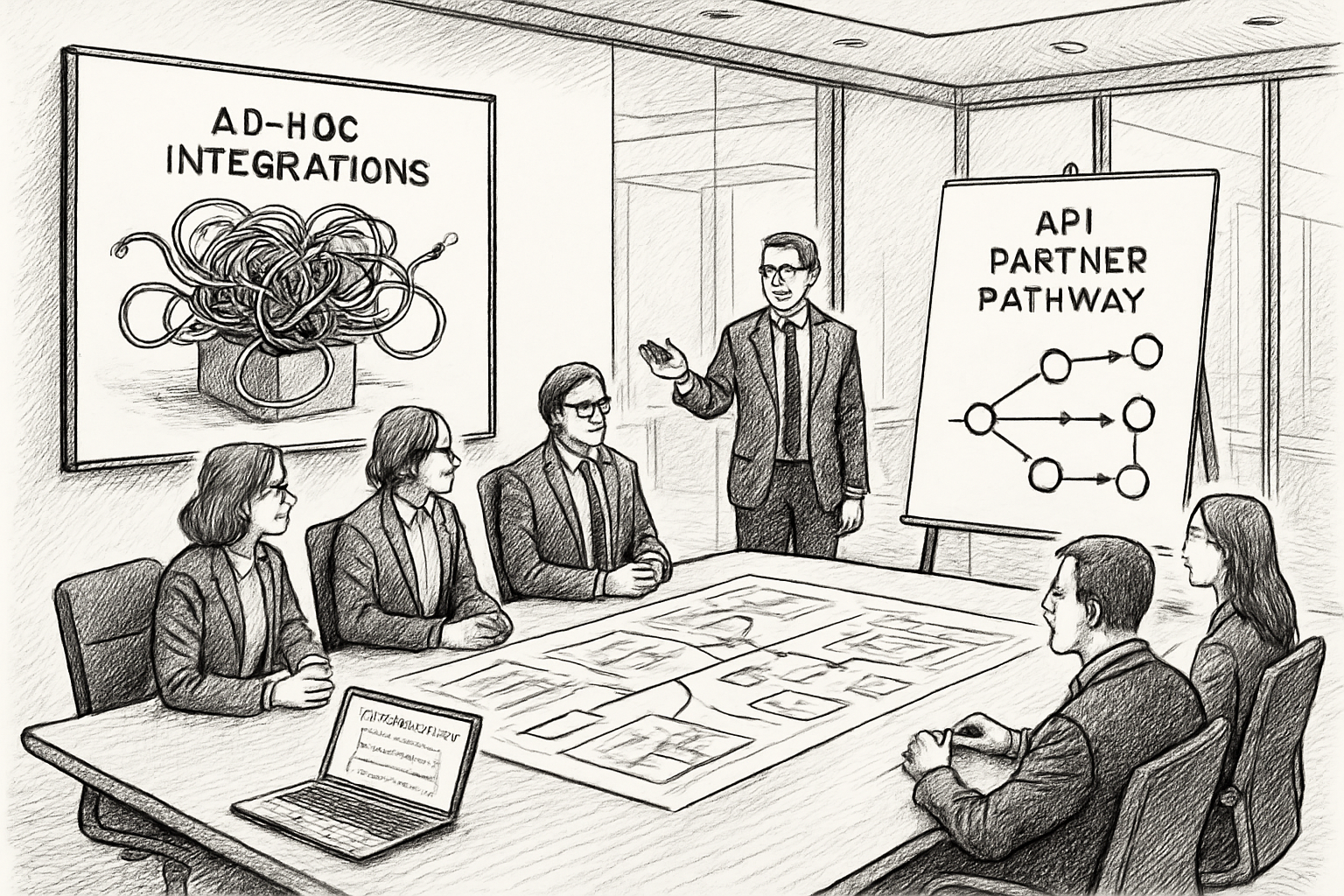
How to Start an API Partner Program: From Ad-Hoc Integrations to a Scalable Ecosystem
You already have an API partner program. You just don't call it one.
If you have partners integrating with your APIs, you have a program. It might run on email threads and Jira tickets. It might depend on three people who know how everything works. Every integration might be effectively one-off, with its own setup process, its own documentation gaps, and its own support channel. But it's a program.
The question isn't whether to start one. It's whether to formalize what you already have before it breaks under its own weight.
This guide is for teams that have outgrown ad-hoc integrations but don't need a 50-page strategy document to move forward. It covers the signs you've hit the wall, what a real partner program looks like, and five concrete steps to get there.
Signs You've Outgrown Ad-Hoc
Ad-hoc integrations work for a while. Then they don't. Here's how you know you've crossed that line.
Partner requests outpace your team's capacity. Business development signs new partners, but your engineering or partner management team can't onboard them fast enough. New partners sit in a queue. The backlog grows. Business asks "why can't we move faster?" and the answer is always the same people.
Every integration is custom. There's no standard process. Partner A was onboarded one way, Partner B another way, and Partner C has a setup that only one person on your team understands. If that person leaves, nobody knows how it works.
You can't answer basic questions. How many partners are active? Which ones are stuck in onboarding? Who's actually making API calls and who signed up six months ago and never came back? If answering these questions requires digging through Slack messages and spreadsheets, you don't have visibility. You have anecdotes.
Legal and compliance are afterthoughts. Some partners have signed terms of service. Some haven't. Data-sharing agreements are inconsistent. Nobody is sure which partners have access to which data. This is manageable with five partners. It's a liability with fifty.
Your team is doing support, not development. Engineers spend their days answering partner questions, provisioning credentials, and troubleshooting integration issues instead of building the product. The team that was hired to build is running a support operation.
What a Partner Program Actually Is
A partner program isn't a landing page that says "become a partner." It's the infrastructure that lets partners integrate with your APIs without requiring your team to be involved in every step.
At its core, a partner program has four things that ad-hoc integrations don't:
- Standardized API products. Instead of custom integrations, you offer defined API products with clear capabilities, usage limits, and pricing. Every partner gets the same product. The product is the interface, not a person on your team.
- A defined onboarding path. Partners know what to do, in what order, without emailing someone to find out. Register, accept terms, get sandbox access, build, apply for production, go live. The steps are documented, visible, and as self-service as possible.
- Formal agreements. Terms of service, data-sharing rules, and access policies that every partner signs. Not negotiated one-off for each relationship, but standardized so you can scale without legal reviewing every new partner individually.
- Visibility into the funnel. You can see how many partners are at each stage. Who's registered. Who's active in sandbox. Who's made their first API call. Who's stuck. This isn't a nice-to-have. It's how you manage the program without managing every partner individually.
The difference between ad-hoc and a program isn't complexity. It's consistency. Every partner follows the same path, plays by the same rules, and gets the same level of service without someone on your team reinventing the process each time.
Five Steps to Formalize What You Have
You don't need to build everything from scratch. You already have partners, APIs, and some version of a process. The work is structuring what exists.
Step 1: Audit your current integrations
Before you build anything new, understand what you have. List every partner integration. For each one, document: what APIs they use, how they were onboarded, what agreements are in place, and whether they're actively making calls. This exercise almost always surfaces surprises. Partners you forgot about. Integrations with no terms of service. Access that should have been revoked months ago.
Step 2: Define your API products
Look at your existing integrations and find the patterns. Most of your partners are probably using the same handful of endpoints for similar purposes. Package those into defined products with clear descriptions, rate limits, and access policies. You don't need ten products. Start with one or two that cover your most common partner use cases. For more on treating your APIs as products, see the API as a product guide.
Step 3: Create standard terms and an onboarding flow
Write a standard terms of service that covers data access, usage policies, and partner obligations. Make it the default for all new partners, and work through your existing partners to get them signed up. Then document the onboarding path: what a partner needs to do, step by step, to go from "interested" to "live in production." The more of this you can make self-service, the less your team is involved in every onboarding. Even if self-service isn't possible today, having a documented path means anyone on your team can run the process, not just the one person who's been doing it from memory.
Step 4: Set up basic visibility
You need to be able to answer three questions at any time: How many partners are active? Where are new partners in the onboarding process? Who's stuck? This can start as a spreadsheet. It should eventually live in your portal. But the important thing is that someone owns this view and updates it regularly. Without it, you're managing by inbox, and you'll only find out about problems when a partner complains or disappears. For a deeper look at what to track, see the metrics that actually matter for API programs.
Step 5: Migrate existing partners into the new structure
This is the step most teams skip, and it's why they end up running two programs: the old ad-hoc one and the new structured one. Reach out to existing partners, get them on the standard terms, move them onto your defined API products, and bring them into the same visibility funnel as new partners. This takes effort, but it's a one-time cost. The alternative is maintaining two systems indefinitely.
What Not to Do
Formalizing a partner program doesn't mean building a massive platform before you can move forward.
Don't wait for perfect self-service. A documented manual process that every partner follows is vastly better than an undocumented manual process that varies every time. You can automate later. Standardize now.
Don't build a marketplace before you have a program. Marketplaces are Stage 4. If you're still figuring out how to onboard partners consistently, a marketplace is a distraction. Get the fundamentals right first.
Don't try to monetize on day one. Adding pricing before you've standardized the product and onboarding path creates friction in two places at once. Get partners successfully integrating with your defined products first. Add monetization once the motion works.
Don't hire partner managers to compensate for a broken process. If onboarding takes too long because the process is manual and undocumented, adding people doesn't fix it. It just gives you more people running a broken process. Fix the process, then decide if you need more people. Most teams find they need fewer than they thought. For specific ideas on reducing onboarding time, start there.
Start With What You Have
You don't need a partner program strategy offsite. You need to take the integrations you already have, find the common patterns, write them down, and make them the standard.
The teams that build successful API partner programs don't start with a blank page. They start with a messy collection of ad-hoc integrations and the willingness to impose structure on it. One standard product. One onboarding path. One set of terms. One place to see who's active and who's stuck.
That's not a massive project. That's a Tuesday. And it changes everything about how your partner program scales from here. For the full picture of how to take a formalized program through scaling and growth, see the complete guide to building a technology partner ecosystem.