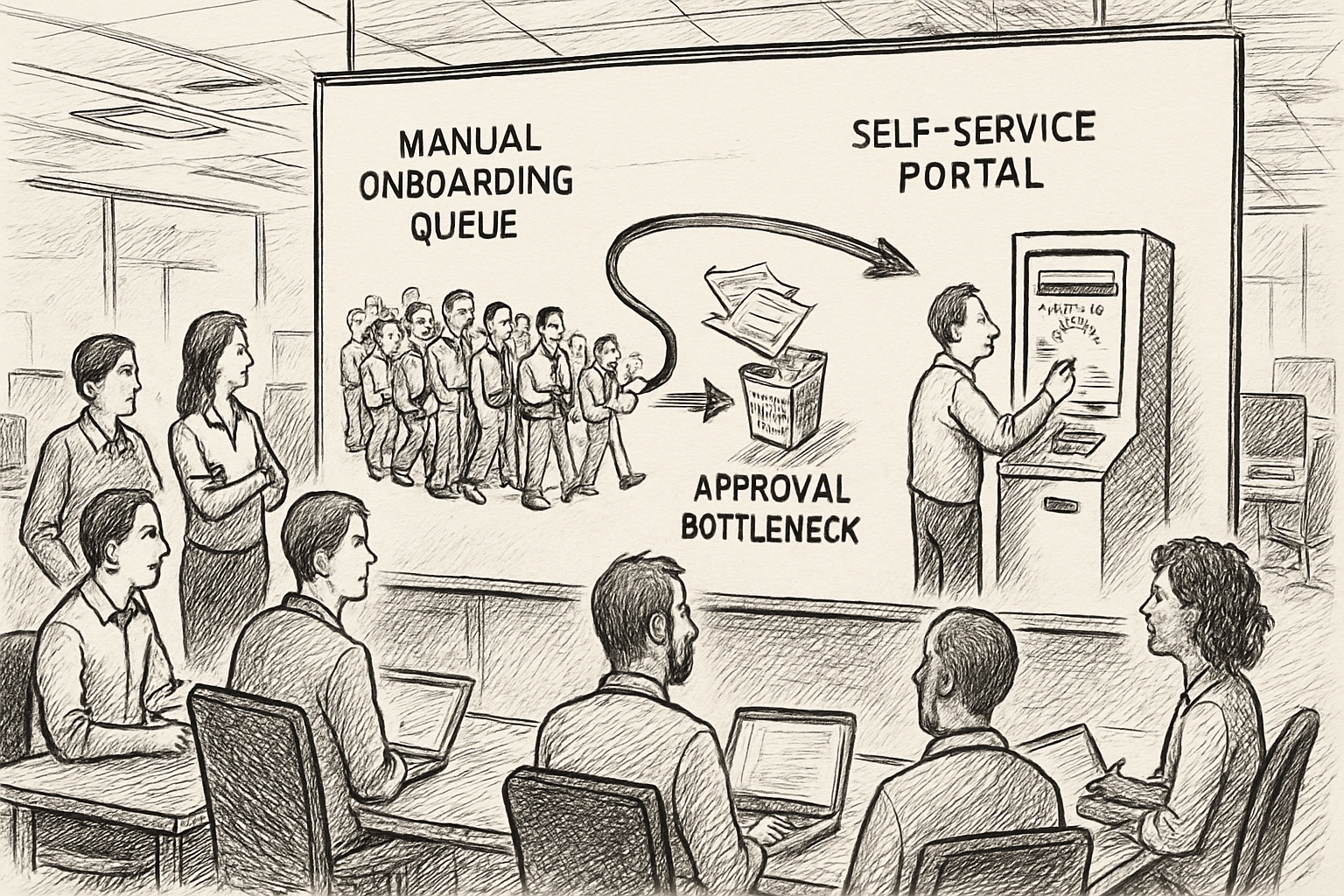
How to Reduce API Partner Onboarding from Months to Days
Your partner pipeline is growing. Business development is signing new integration partners every month. Leadership is excited about the API program's potential.
And then onboarding becomes the bottleneck.
Every new partner needs credentials, documentation access, sandbox environments, terms of service agreements, and someone from your team to walk them through it. The process that worked for five partners doesn't work for fifty. Partner requests start outpacing your team's ability to onboard them, and the partners who do get through take weeks or months instead of days.
This is the manual onboarding trap. It doesn't announce itself with a single dramatic failure. It creeps up slowly until your partner program is growing on paper but stalling in practice.
This guide breaks down the specific bottlenecks that turn days into months and the changes that fix them without requiring a massive platform rebuild.
Why Manual Onboarding Becomes the Bottleneck
Manual onboarding works when you have a handful of partners. You know each one by name, you can handle requests over email, and the engineering team has bandwidth to set up environments one at a time.
But manual processes scale linearly with headcount. Every new partner requires the same coordination: someone sends credentials, someone provisions access, someone walks through the docs, someone handles the legal agreements. Each integration ends up being effectively one-off.
The math catches up fast. If onboarding one partner takes two weeks of elapsed time and involves three people on your team, ten partners don't take two weeks. They take months, because each one is waiting in the queue for the same people's attention.
Meanwhile, partners expect the Stripe and Twilio experience: sign up, get keys, read docs, make a call, go live. When they hit your email-based onboarding process instead, the best ones slow down. The rest walk away.
The Five Bottlenecks That Turn Days into Months
Onboarding delays rarely come from one big problem. They come from friction accumulating across five areas.
1. Credential provisioning requires engineering
If generating API keys, creating sandbox environments, or configuring OAuth clients requires someone from engineering, you've created a dependency that blocks every other step. Partners can't test anything until they have credentials, and credentials are stuck behind an engineering ticket.
The fix: partners generate their own credentials through a self-service portal. No tickets, no waiting.
2. Documentation lives in the wrong places
API docs in Confluence. Getting-started guides in Google Docs. Code samples in a GitHub repo that partners may not have access to. When documentation is scattered across systems, partners spend more time finding information than using it.
The fix: all documentation lives in one place, accessible the moment a partner registers. Interactive docs where they can try endpoints with their own credentials, not just read about them.
3. Legal and compliance are serial, not parallel
Terms of service, data processing agreements, NDAs. These are necessary, but when they're handled through email chains and PDF attachments, they add weeks. Each agreement goes to legal, sits in a queue, gets reviewed, comes back with comments, and the partner waits.
The fix: standard terms are accepted digitally during registration. Custom agreements happen in parallel with technical onboarding, not before it. Partners can start building in sandbox while legal runs its process for production access.
4. There's no clear path from sandbox to production
Partners get sandbox access, build their integration, and then hit a wall. "What do I do to go live?" The answer involves emailing someone, filling out a form that lives somewhere else, waiting for an internal review with no visible status, and hoping someone follows up. The gap between "it works in sandbox" and "it works in production" is where partners stall for weeks.
The fix: a clear, visible promotion path. Partners know exactly what's required for production access, can submit their application through the portal, and can see where they are in the review process.
5. Nobody knows who's stuck
Without visibility into the onboarding funnel, your team can't tell which partners are progressing and which ones signed up two months ago and never made an API call. You find out a partner is stuck when they send a frustrated email, or worse, when they don't send anything at all and quietly disappear.
The fix: track the funnel. Registration to sandbox. Sandbox to first API call. First call to production. Measure the metrics that actually matter and you'll see exactly where partners drop off.
What Fast Onboarding Actually Looks Like
When onboarding works, a partner's first day looks like this:
- Register. Partner creates an account, accepts terms of service, and provides the information you need to vet them. This takes minutes, not meetings.
- Get sandbox access. Immediately after registration, the partner has API credentials, access to interactive documentation, and a sandbox environment to build against. No waiting for someone to provision anything.
- Make the first API call. Within the first session, the partner has made a successful call. Time to first API call is the single best indicator of onboarding health. If it's measured in hours, you're doing well. If it's measured in weeks, something is broken.
- Build and test. The partner builds their integration in sandbox at their own pace. Documentation, code samples, and support resources are all accessible from the same place.
- Apply for production. When the integration works, the partner submits a production application through the portal. They can see the requirements, track their status, and know what's coming next.
- Go live. After approval, production credentials are generated automatically. The partner is live.
The difference between this and manual onboarding isn't a slightly faster version of the same process. It's a fundamentally different model. Partners drive their own onboarding. Your team manages by exception instead of managing every individual partner.
How to Get There Without a Massive Project
You don't need to fix everything at once. Start with the bottleneck that's costing you the most time and work forward.
Step 1: Make credentials self-service
This is the highest-leverage change. If partners can generate their own API keys and access sandbox environments without filing a ticket, you've removed the single biggest dependency from the onboarding flow. Everything downstream gets faster because partners aren't waiting for your engineering team to do something only your engineering team can do today.
Step 2: Put documentation where partners already are
Centralize docs in your API portal, not in a separate wiki. Include interactive "try it" functionality so partners can test endpoints with their credentials directly from the documentation. Good docs don't just explain the API. They let partners prove it works before writing integration code.
Step 3: Digitize terms acceptance
Move terms of service and agreements into the registration flow. Partners accept standard terms digitally, and you have an auditable record of who accepted what and when. For partners who need custom agreements, let them start in sandbox while the custom terms are negotiated. Don't let legal block technical progress.
Step 4: Build a visible sandbox-to-production path
Define what production readiness looks like. Make the criteria visible to partners. Let them submit their application and see their status. This doesn't need to be a complex workflow engine. Even a clear checklist that partners can follow and your team can review is a massive improvement over email-based coordination.
Step 5: Measure the funnel
Track where partners are in the onboarding journey: registered, active in sandbox, first API call, applied for production, live. When you can see the funnel, you can see where partners drop off. When you can see where they drop off, you can fix it. For a deeper look at which metrics to track, see what to measure in your API program.
The Real Cost of Slow Onboarding
Slow onboarding isn't just an operational inconvenience. It has real business costs that compound over time.
- Lost partners. Partners who take too long to onboard lose momentum. Their internal champion moves on to other priorities, budgets get reallocated, and the integration never ships.
- Engineering drag. Every hour your engineering team spends provisioning credentials and answering onboarding questions is an hour they're not spending on the product. The team becomes a support function instead of a development function.
- Revenue delay. If you're monetizing your APIs, every week of delayed onboarding is a week of delayed revenue. Multiply that across your partner base and the cost adds up fast.
- Reputation. Partners talk to each other. A slow, painful onboarding experience becomes your reputation in the market. Fast, professional onboarding becomes a competitive advantage.
Start With One Change
You don't need to transform your entire partner onboarding process overnight. Pick the bottleneck that hurts most. For most teams, that's credential provisioning. Make it self-service, measure the impact, and use that win to build momentum for the next improvement.
The teams that move their API programs from cost center to growth engine don't do it with a single big project. They do it by systematically removing the friction that sits between a partner signing up and a partner going live.
The goal isn't a perfect onboarding experience on day one. The goal is to stop losing partners to a process that should have been automated months ago. For a broader look at how an API portal fits into this picture, including the build-versus-buy decision, start there.