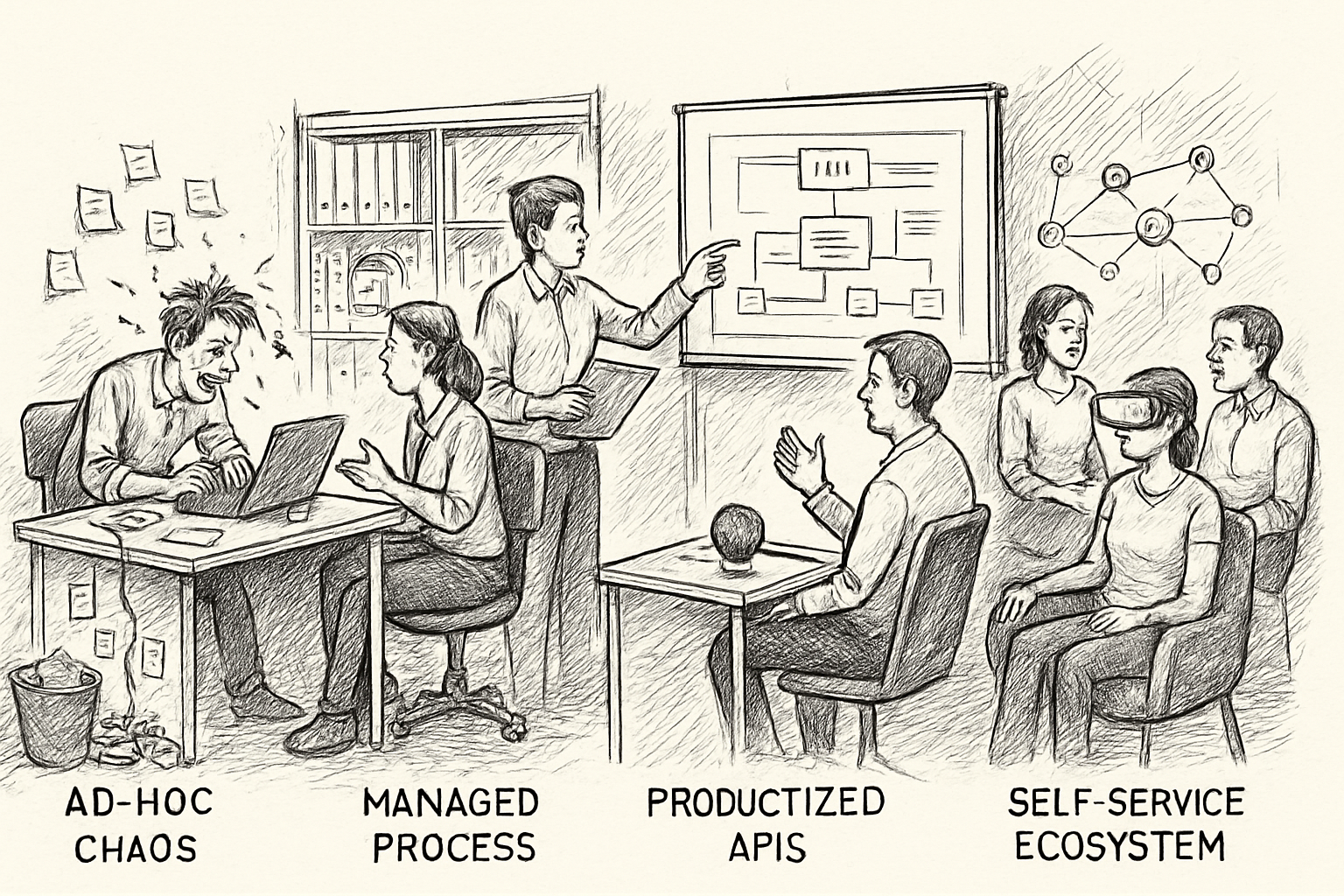
Partner Program Maturity Model: From Ad-Hoc Integrations to a Self-Service Ecosystem
Every API partner program goes through the same evolution. It starts with a few one-off integrations. It ends (if it gets there) with a self-service platform where partners onboard, build, and pay without your team being involved in every step.
The problem is that most teams can't see which stage they're in. They know the current process isn't working, but they don't know whether they need a small fix or a structural change. And they waste time building for Stage 4 when they haven't solved the problems of Stage 2.
This model describes the four stages, the symptoms that tell you where you are, and what it actually takes to move from one stage to the next.
The Four Stages
| Stage | Name | Partners | How it works |
|---|---|---|---|
| 1 | Ad-hoc | 1-10 | Every integration is custom. One person knows how it works. |
| 2 | Managed | 10-30 | There's a process, but it's manual. The team is the bottleneck. |
| 3 | Productized | 30-100 | APIs are packaged as products. Onboarding is documented. Pricing exists. |
| 4 | Self-service | 100+ | Partners onboard, subscribe, and go live without your team. |
The partner counts are rough guides, not hard thresholds. Some teams hit Stage 2 problems at five partners. Others manage 50 in ad-hoc mode through sheer effort. The stage is defined by how the program operates, not how many partners it has.
Stage 1: Ad-Hoc
How it works: Partners integrate through direct relationships. Each one gets a custom setup. The person who handles onboarding knows every integration by name. There's no standard process because every partner is different.
Symptoms:
- Each integration is effectively one-off
- Onboarding knowledge lives in one person's head
- No standard terms of service or data agreements
- Partners contact your team directly for everything: credentials, documentation, troubleshooting
- Nobody can answer "how many active partners do we have?" without checking multiple systems
What works at this stage: Speed. You can move fast because there's no process overhead. Every partner gets personal attention. The relationships are strong.
What breaks: The person who manages everything goes on vacation (or leaves). A new partner request takes two weeks because the queue is full. Leadership asks for a partner count and you spend a day piecing it together.
Moving from Stage 1 to Stage 2
The transition to managed isn't about building a platform. It's about writing things down.
- Document the current process. Whatever the person who handles onboarding does, write it down step by step. Not as an ideal process. As the actual process, warts and all.
- Create standard terms. One set of terms of service that every new partner signs. Doesn't need to be perfect. Needs to exist.
- Build a partner list. Every active partner, what APIs they use, when they were onboarded, and whether they have signed terms. A spreadsheet is fine. The goal is to have one source of truth.
For a detailed walkthrough, see how to start an API partner program.
Stage 2: Managed
How it works: There's a defined process. Someone owns it. New partners follow a sequence of steps: submit a request, sign terms, get credentials, access documentation, start building. It's documented. It's repeatable. It's also entirely manual.
Symptoms:
- There's a process, but it depends on specific people to execute it
- Onboarding takes days or weeks because each step requires someone's time
- The team can handle current volume but can't take on more without adding headcount
- Partner information is tracked in spreadsheets or project management tools
- You can answer "how many partners?" but not "where are they stuck?" or "which ones are growing?"
What works at this stage: Consistency. Every partner goes through the same steps. You can train new team members on the process. Compliance is manageable because there's a record (even if it's a spreadsheet).
What breaks: Scale. The business wants 50 partners but the team can onboard 20. Adding headcount helps linearly but costs proportionally. Partners who expect the Stripe/Twilio experience hit your email-based process and lose momentum.
Moving from Stage 2 to Stage 3
The transition to productized is about packaging your APIs as products that partners can evaluate and adopt without custom work.
- Define API products. Look at your existing integrations and find the patterns. Most partners use the same handful of endpoints for similar purposes. Package those into named products with descriptions, rate limits, and pricing (even if pricing is $0 for now).
- Create a sandbox. Partners need to test before they commit. A sandbox environment that mirrors production, with self-service credential generation, eliminates the biggest onboarding bottleneck.
- Centralize documentation. Move docs from scattered wikis and email attachments into one place. Interactive documentation where partners can try endpoints with their own credentials is the target.
- Automate credential provisioning. This is the single highest-leverage change. If partners can generate their own API keys without filing a ticket, onboarding time drops from weeks to hours.
Stage 3: Productized
How it works: APIs are packaged as products with defined capabilities, pricing tiers, and terms. Partners browse a catalog, choose a product, and understand what they're getting before they start. Onboarding is partially automated: sandbox access is self-service, documentation is centralized, credentials are generated automatically. Production access still requires approval.
Symptoms:
- You have defined API products with pricing (or at least tiers)
- Partners can get started in sandbox without your team's involvement
- Onboarding time is measured in days, not weeks
- You have visibility into partner activity: who's active, who's stuck, who's growing
- Some partners still need hand-holding for production, but most follow the documented path
- Revenue from API access exists (or the pricing model is defined and ready to launch)
What works at this stage: Scalability. You can onboard more partners without proportionally growing the team. The API products are clear enough that partners self-select the right tier. Pricing captures some of the value the program creates.
What breaks: The last-mile automation. Production approval is still manual. Billing might still involve spreadsheets. Partner lifecycle management (renewals, upgrades, offboarding) requires human coordination. You're scaling, but every new partner still creates a marginal task for someone.
Moving from Stage 3 to Stage 4
The transition to self-service is about eliminating the remaining manual touchpoints.
- Automate production access. Define the criteria for production approval. If it can be expressed as rules (sandbox integration verified, terms signed, payment method on file), it can be automated. Reserve human review for exceptions, not every application.
- Automate billing. Connect your pricing model to automated billing. Usage tracking, invoicing, and payment collection should happen without someone processing a spreadsheet. Platforms with Stripe integration handle this out of the box.
- Build the partner portal. A single place where partners manage everything: subscriptions, credentials, usage dashboards, billing, team members. Self-service means the partner controls their own lifecycle.
- Implement analytics. You need to see the funnel (registration > sandbox > production > revenue), identify drop-off points, and measure the metrics that matter to leadership. At this stage, data drives decisions about the program, not anecdotes.
Stage 4: Self-Service
How it works: Partners discover your API products, register, get sandbox access immediately, build their integration, apply for production, subscribe to a paid plan, and go live. Your team manages the platform, not individual partners. Exceptions are handled through workflows, not email.
Symptoms:
- Partners onboard without engaging your team
- Time to first API call is measured in minutes or hours
- Billing is automated: usage-tracked, invoiced, collected
- You have a clear funnel with conversion data at every stage
- Your team focuses on platform improvement and strategic partnerships, not onboarding operations
- The program generates measurable revenue and can prove its ROI to leadership
What works at this stage: Everything compounds. More partners make the platform more valuable. Revenue grows without proportional cost increases. Leadership sees the program as a business asset, not overhead. You've built something a competitor can't replicate in a quarter.
What still needs attention: Strategic partner relationships that go beyond self-service (enterprise deals, co-marketing, custom integrations). Platform evolution: new API products, new pricing models, new partner segments. And ongoing governance: access control, scope management, and compliance, especially in regulated industries.
Where Are You?
Read the symptoms for each stage. You're at the stage where the problems sound most familiar.
If you're at Stage 1, don't try to jump to Stage 4. Write things down, create standard terms, and build a partner list. That's your next step.
If you're at Stage 2, don't hire more people to do manual work faster. Package your APIs into products and make sandbox access self-service. That's your next step.
If you're at Stage 3, don't build a marketplace. Automate the last-mile: production approvals, billing, and partner self-service. That's your next step.
Each stage solves the problems of the previous stage. Skip a stage and you'll build infrastructure on a foundation that can't support it.
For the complete guide to building a partner ecosystem from Stage 1 through Stage 4, see how to build a technology partner ecosystem with APIs.